Museo Civico Archologico di Bovino
Caricamento in corso...

Archeological
Museum
of Bovino

Enter and discovery the collection

The Stele
Anthropomorphic

Testimonies of the Copper Age

The Art of
Ceramics

Ceramic Production

Image PLAY NOW - PLAY NOW - PLAY NOW -
Evolution of a story

Museum History

THE MUSEUM HEADQUARTERS: PALAZZO PISANI

Read more
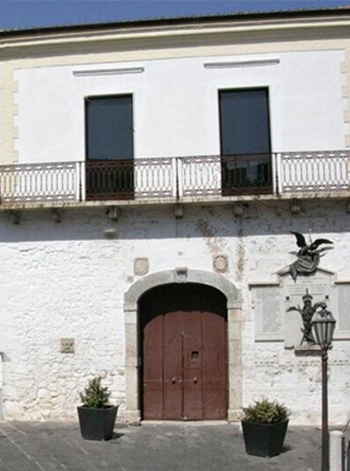
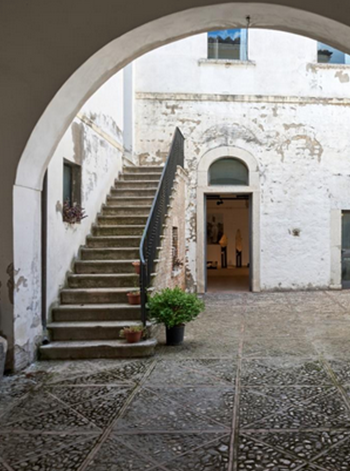
The Carlo Gaetano Nicastro Civic Museum is housed in Palazzo Pisani, an ancient building located in the heart of the historic center of Bovino. It originally belonged to the noble family from which it takes its name in the early 18th century. Purchased by the bishop of the Diocese of Bovino in 1704 and later by the Provincial Administration of Capitanata in 1888, it served as the headquarters of the Royal Carabinieri barracks until the 1960s. Since 1987, the building has been under protection.

THE NICASTRO COLLECTION

Read more
The original collection of artifacts preserved in the Museum comes from the donation of Carlo Gaetano Nicastro, who was appointed First Honorary Inspector of Monuments and Antiquities in 1912. A local scholar and promoter of the museum’s establishment in 1925, he laid the foundation for its collection. Over time, additional acquisitions have enriched the museum, including the anthropomorphic stelae discovered in the Sterparo Nuovo area and a numismatic collection.

HISTORY OF THE COLLECTIONS

Read more
Since the 1980s, the territory of Bovino has been the focus of numerous scientific studies that have contributed to expanding knowledge of the area. Notable among these are the research conducted by Marina Mazzei, the excavations at the Tegole and Sterparo sites led by Anna Maria Tunzi, the stratigraphic investigations of the Casalene villa directed by Marisa Corrente, and the recent surface survey campaigns carried out by the University of Foggia.
Information  and Bookings

Information and Bookings

Image
  • Days and Hours
    Days and Hours

    Saturday, Sunday, and public holidays:
    10:30 AM - 12:30 PM and 4:00 PM - 6:00 PM.
    Every day by reservation.

  • Book your visit
    Book your visit

    Click on "Plan Your Visit"
    Or call +39 339 168 6839

  • Where we are
    Where we are

    Piazza Marino Boffa
    71023 Bovino (FG)

Our services
Visit the Archeological Museum of Bovino

Our services

Image
Image

AUDIOGUIDES

Read more
The audioguides, available in Italian and English, can be rented at the Museum's information desk. The tour guides the visitor through the Museum's exhibition path, following a chronological order with insights into specific artifacts. It allows visitors to explore the rooms independently, offering scientific content in a simple and straightforward language.
Image
Image

Multimedia room

Read more
(Coming soon)
Image
Image

KIDS

Read more
The Museum offers a wide range of educational activities designed for schools and families, structured for different age groups, exploring the collection of the C. G. Nicastro Civic Museum and the ancient village of Bovino.
Image
Image

Tactile Path

Read more
The Museum offers an exhibition path that provides a new approach to the museum experience, making it engaging, dynamic, multisensory, and accessible to all. Through direct contact with some of the most significant archaeological artifacts in the collection, along with a brief description in Braille, a pathway has been developed to enhance the understanding of materials, shapes, functions, and meanings.

FROM THE TERRITORY TO THE MUSEUM

Exhibition Routes

Exhibition Routes

THE NEOLITHIC AND ENEOLITHIC PERIODS
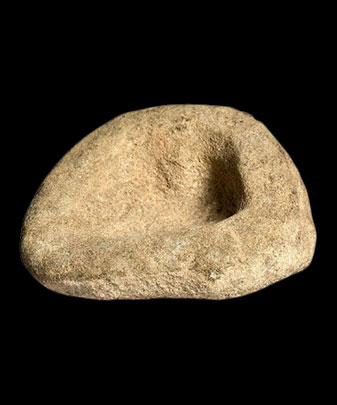
An understanding of settlement in the Bovino area during the neolithic period can be gained from several sites which were identified thanks to the discovery of various finds above ground. These came from places such as the areas of Radogna (a pickaxe) and Catenazzo (stone implements) and from the site in La Lamia, which was characterised by traces attributable to compounds visible in the aerial photographs taken by John Bradford during the Second World War. In addition to this there have been occasional discoveries from the sites in Monte Castro, Iancoppa, Casale and Casalene. Recently, as well as these, which are already well-known and largely datable to the earliest period, other sites located along the Bovino hillside have been identified. These would seem to demonstrate the presence of settlements throughout the neolithic period (Radogna, I Valli, Carripoli, Serrone, San Lorenzo, Masseria Serroncino, Casalene).

Apart from the conspicuous number of steles which have been discovered since the 1950s in the areas of Giardinetto and Sterparo, the eneolithic phase is marked by a vast and organised settlement on Tegole hill, identified by investigations using preventive archaeology. In addition, in Giardinetto, during work to upgrade the railway to a double track line, an extensive cremation necropolis was uncovered made up of various funeral enclosures. The latest research into the landscape carried out by the University of Foggia has revealed the presence of over 100 areas where artefacts can be found above ground. These testify to the great vitality of the pattern of settlement between the Eneolithic period and the Bronze Age. Archaeological investigations in the Tegole-Cologno area have led to the identification of a village which was already occupied in the neolithic period and which underwent a new and distinct organisation of its dwellings in the eneolithic period. This involved the construction of defensive palisades to protect against the strong gusts of wind which are typical of this hilly area and continued up to the last phase of occupation when the dwellings likely took on a religious function and it became a place of worship.
THE STELES
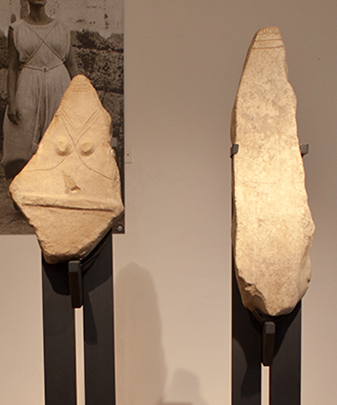
Since the 1950s, over thirty anthropomorphic steles have been discovered by farmworkers near the Sterparo site, which is situated between Bovino and Castelluccio dei Sauri.  They are made of limestone and sandstone and can be dated to the Eneolithic period.  The front sides of these monuments are carved, unlike the rear sides, which have been left coarse, probably because they were intended to be viewed from the front.  The lower sections, some of which are tapered to help with their placement in the ground, are mostly uneven and show less attention to detail.   The decorative elements on the stones are carved, engraved or sculpted in the body of the stele, while representations of breasts and rope are the only parts which are carved in relief. The uniqueness of vibinate production comes from the absence of any customisation of the stone slabs in favour of the glorification of male and female strength. In ethical and spiritual terms this can be seen in the symbolic  figures which are especially connected to worship and religious concepts.
THE DAUNIAN AND PRE-ROMAN PERIOD
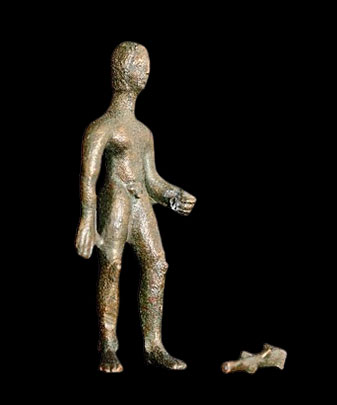
Traces relating to the Daunian and pre-Roman period (VIII-VI century BC) when contact and exchanges with the Irpinian-Samnite area were even more intense, are seen in sites such as the one in Tegole-Carsogni. Here, archaeological investigations carried out by M. Corrente have allowed a small burial ground to be identified which can be dated to the VI to V centuries BC. At the Giardinetto site a settlement has been identified which dates back to some time between the Eneolithic period and the IV century BC. Some of the exhibits in the museum point to the vibrancy of relations with the Irpinian-Samnite area. One such artefact, for example, is a bronze statue of Hercules holding a club, a deity closely associated with herding and pastoral culture. One interesting exhibit, which is a measure of the strategic position of Bovino hill, as well as of the ongoing political and social upheaval during the IV-III centuries BC, is the so-called “Bovino cup”, a distinctive clay artefact bearing graphic symbols which belong to the Messapian and Punic alphabet. This artefact may have held a magical value and is evidence of the transit and presence of Carthaginian troops led by Hannibal (who, according to historical sources and also to an inscription preserved in Brindisi, set up camp near to the centre of Vibinum) during the Second Punic War.
THE ROMAN CITY
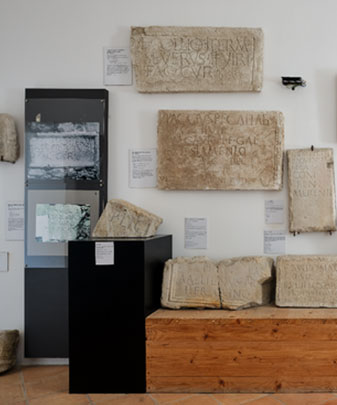
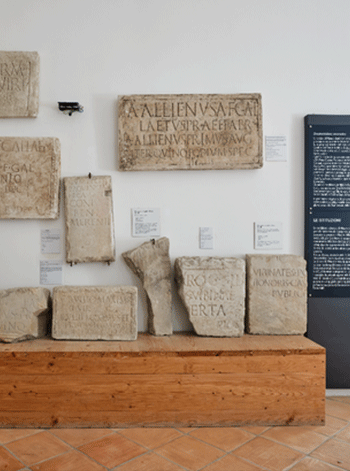
During the Roman period Bovino (Vibinum) became a fully fledged urban centre. The museum houses an epigraph which mentions the colony of Vibina, which between 195 and 197 AD dedicated a statue to Caracalla, who at that time was not yet emperor. This epigraph documents the transition of the vibinate centre from Roman municipium to Latin colony in the first century BC, although the area had been occupied since the third century BC. During the first century BC the aqueduct and the perimeter wall were built. One of the aqueduct’s arches is visible in the area of Mura d’Acque while various stretches of the wall are preserved in the present-day town (at the “Buco di San Marco”, in private courtyards in via Lastene, in via Castello, at the Duke’s Palace and on the ramp in via Mentana). The modern centre of Bovino has developed along the lines of its ancient centre, as evidenced by the decumanus maximus which the modern-day via Roma runs along. Many of the inscriptions housed in the museum come from the area of the forum, where the present Cathedral Square is located. The discovery of two mosaics made from black and white tiles dating from the early imperial period are evidence of residential buildings. These came from a domus (house) in via Lastene and from a baths complex located nearby. Meanwhile the burial grounds are situated in the vicinity of the modern-day municipal gardens in the direction of the Capuchin Monastery (the modern-day Saint Anthony’s?) and towards the River Cervaro. A stone sphinx and a funerary relief showing a female figure, which are housed in the museum, probably acted as markers for two different tombs. Other finds such as bronze brooches, oil lamps and ointment jars comprise the grave goods unearthed in this area which can be dated between the 2nd century BC and the 2nd century AD.
RURAL SETTLEMENTS AND MATERIAL CULTURE
The archaological research which has involved Bovino in the last few years has led to the identification of a large number of sites, many of which are characterised by forms of occupation, long-lasting in nature, from the Prehistoric age to late antiquity and the early middle ages. The sites are Casale, Casalene, San Lorenzo and Radogna, which are located in strategic positions near important roads and waterways. The analysis of aerial photographs, together with the gathering of artefacts at ground level, has led to the identification of a villa in the area of Casale. This is characterised by an extensive and organised layout which was probably enclosed by walls and fortifications. It is also distinguished by its high level of decoration as well as the presence of areas of production. The Roman villa at the Casalene site is another interesting example. Here the walls are well-preserved, having been subsequently used in the present-day farmhouse. The villa was occupied from the late Republican period until late antiquity and included baths and areas dedicated to production, especially that of olive oil. Sporadic discoveries made in the area of Bovino hill are evidence of intense occupation in the republican and imperial periods. This occupation was intended for productive purpose as is shown by several finds from the areas of S. Lorenzo, Radogna, Torre Guevara (where a vicus from the late imperial period has been documented), Masseriole and Catenazzo. These finds include structures for olive pressing, clay bricks and bases for oil mills. The millstones for oil and wheat and numerous loom weights which are housed in the museum demonstrate the vitality of the agrarian economy in addition to the breeding of herd animals and sheep farming in the area. In the area of Radogna, which has already been mentioned due to its occupation in the Eneolithic period, the discovery of artefacts at ground level has confirmed the occupation of the site up to the early middle ages. These artefacts are connected to productive activity and are evidence of residential structures.
BOVINO IN THE MEDIAEVAL PERIOD
Late antiquity and the early mediaeval period marked a downgrading of the settlement of Bovino to that of vicus, or village. It seems likely that a church was built in the area of the forum and the amphitheatre of the Roman city. The area was apparently affected by the Lombard and Byzantine presence, as demonstrated by the presence of governor-bishops and catepans from the second half of the IX century. From the XI century the settlement maintained and strengthened its role as a strategic hub with regard to the Bovino Valley; during this phase, work to extend the old Roman perimeter wall was carried out. The city took on greater importance in the Norman Age as evidenced by the presence of the cathedral and the adjacent church dedicated to Saint Mark, the settlement’s patron saint. This constitutes one of the first examples of Romanesque in Puglia. This importance is further evidenced by the rebuilding work to extend the castle. Some fragments of sculptures which came from the cathedral and which can be dated to the VIII-X centuries clearly show Beneventan and also Islamic stylistic influences. These fragments attest to the presence of stonemasons on site who used the Lombard style, which can be seen in some of the fragments in the Nicastro Collection. Other elements relate to slabs, capitals, pier caps and epigraphs from Saint Peter’s Church, which can be dated to the XI century. Lastly, there are some examples of epigraphs and burial slabs which relate to the modern period (XVI-XVIII centuries) In addition there are many interesting multicoloured painted majolica artefacts housed in the Nicastro Museum. The stylistic and morphological features of the Bovino material make it possible to closely link it with the factory in Ariano Irpino. This was the only factory, together with one in Grottaglie, to produce this type of everyday articles in the XVIII and XIX centuries. These articles include pitchers, mugs, flasks and above all stoups, which were often made using an architectural style which imitated a church altar and which were widely produced in the XVIII and XIX centuries.
News and events

Events

21 Maggio 2026

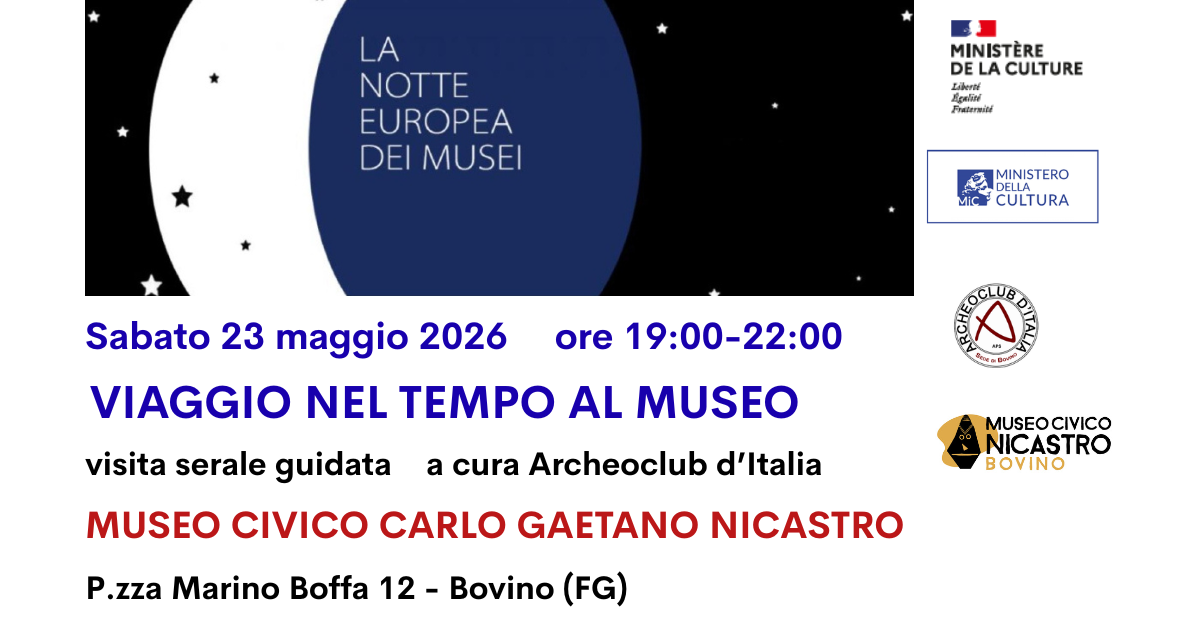
Notte europea dei musei- Viaggio nel tempo al museo

Il 23 maggio torna la Notte europea dei musei promossa dal Ministero della Cultura francese e patrocinata dal Ministero della Cultura italiano. Anche quest’anno Bovino aderisce all’iniziativa con un doppio appuntamento. Dalle ore 19.00 alle ore 22.00, Viaggio nel tempo al Museo! visita serale guidata al Museo civico Carlo Gaetano Nicastro. 

21 Maggio 2026

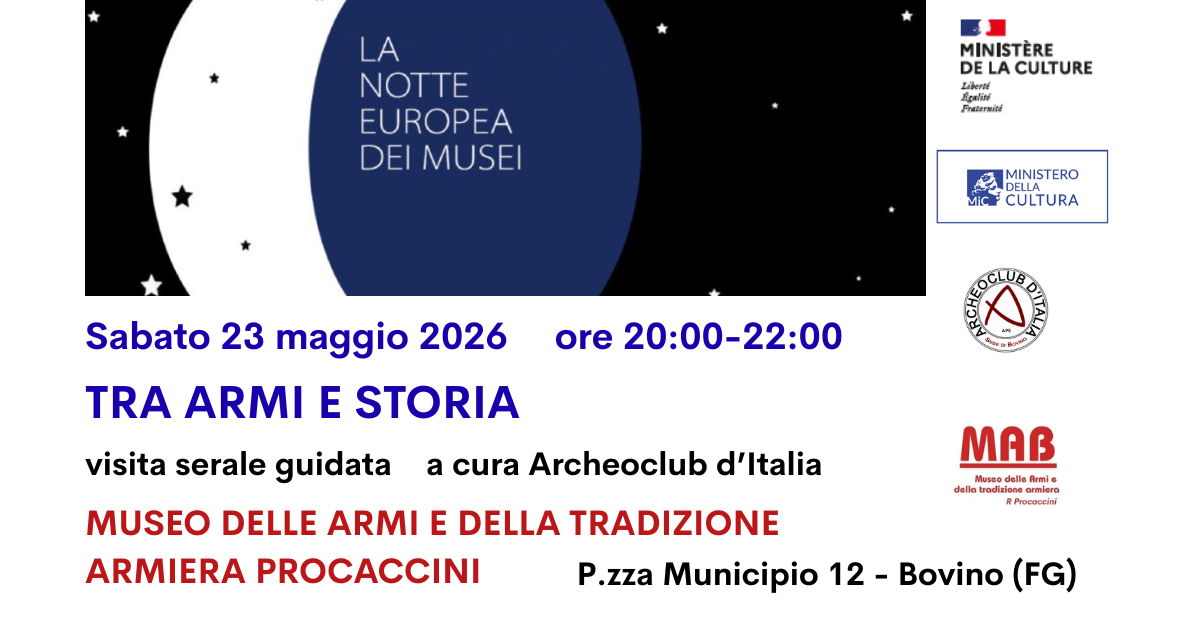
Notte europea dei musei – Tra Armi e Storia

Il 23 maggio torna la Notte europea dei musei promossa dal Ministero della Cultura francese e patrocinata dal Ministero della Cultura italiano. Anche quest’anno Bovino aderisce all’iniziativa con un doppio appuntamento. Dalle ore 20.00 alle ore 22.00, Tra armi e storia! visita serale guidata al Museo delle armi e della tradizione Armiera Procaccini.

19 Dicembre 2024

CITIZEN HISTORY ALL’UNIVERSITÀ

Il 15 novembre il nostro progetto di storia di comunità sarà ospite del Dipartimento di ricerca e innovazione umanistica dell’Università di Bari, che ne è partner scientifico. L’incontro avrà luogo nell’ambito del corso di Storia culturale della professoressa Claudia Villani, e vedrà la partecipazione del dottor Marco Occhipinti e della dottoressa Antonella Fiorio. Buon lavoro […]

Support the Museum Too

Support the Archeoclub

Contact us: museobovino@gmail.com